
Code generation is one of the most exciting new technologies in software development. AI tools can now generate code that is just as good, or even better, than human-written code. This has the potential to revolutionize the way we write software.
Explore 5 Customer Service AI Tools
AI code generation tools do exactly that but in the ocean of programming, helping navigate, create better ‘boats’ (codes), and occasionally introducing innovative tweaks to enhance performance and efficiency.
Why use AI Tools for Code Generation?
AI code generation models are advanced artificial intelligence systems that can automatically generate code based on user prompts or existing codebases. These models leverage machine learning and particularly deep learning algorithms to understand coding patterns, languages, and structures.It’s important to explore the major reasons for using AI tools and techniques for code generation. Key benefits include:
Enhanced Efficiency
They can automate routine and repetitive coding tasks, significantly reducing the time programmers spend on such tasks. This leads to faster code production and allows developers to concentrate on more complex and creative aspects of programming.Improved Code Quality
By enforcing consistency and adhering to best coding practices, AI code generation models can improve the overall quality of code. This is beneficial for both seasoned developers and newcomers to the field, making the development process more accessible.
Consistency and Teamwork
These models help maintain a standard coding style, which is especially useful in team environments. A consistent codebase improves comprehension and collaboration among team members.Empowering Non-Developers
AI code generators can empower non-developers and people new to coding by simplifying the code creation process and making development more inclusive.Streamlining Development
By generating code for machine learning models and other complex systems, AI code generation tools can streamline the development process, enabling programmers to create robust applications with less manual coding effort.Read more about the top 8 AI tools for code generation
How to use AI tools for Code Generation?
Let's envision a scenario where a developer, Alex, is working on a project that involves writing a Python function to fetch data from a weather API. The function must take a city name as input and return the current temperature. However, Alex isn’t entirely sure how to construct the HTTP request or parse the API’s JSON response.Using an AI code generation tool like GitHub Copilot, which is powered by OpenAI Codex, Alex starts typing a comment in their code editor, describing the functionality they desire:
With Copilot active, the tool reads this comment and begins to generate a potential Python function below it:
In the generated code, Copilot creates a function get_temperature and automatically imports the requests library to make HTTP requests. It builds the URL for the API request using an API key placeholder and the input city_name, then sends a GET request to the weather API. Finally, it parses the JSON response to extract and return the current temperature.
Note: The API key and base_url may need to be modified according to the actual weather API documentation that Alex chooses to use.
Alex now has a robust starting point and can insert their actual API key, adjust endpoint URLs, or modify parameters according to their specific use case. This code generation saves Alex time. It also provides a reliable template for interacting with APIs. This is helpful if they’re unfamiliar with making HTTP requests in Python.
Such AI tools analyze patterns in existing code and generate new lines of code optimized for readability, efficiency, and error-free execution. Moreover, these tools are especially useful for automating boilerplate or repetitive coding patterns, enhancing the developer’s productivity by allowing them to focus on more complex and creative aspects of coding.
How to fix bugs using AI tools?
Imagine a developer working on a Python function that finds the square of a number. They initially write the following code:Here, there’s a syntax error - the multiplication operator * is mistakenly written as x. When they try to run this code, it will fail. Enter GitHub Copilot, an AI-powered coding assistant developed by GitHub and OpenAI.
Upon integrating GitHub Copilot in their coding environment, the developer would start receiving real-time suggestions for code completion. In this case, when they type return num, GitHub Copilot might suggest the correction to complete it as return num * num, fixing the syntax error, and providing a valid Python code.
The AI provides this suggestion based on patterns and syntax correctness it has learned from numerous code examples during its training. By accepting the suggestion, the developer swiftly moves past the error without manual troubleshooting, thereby saving time and enhancing productivity.
GitHub Copilot goes beyond merely fixing bugs. It can offer alternative methods, predict subsequent lines of code, and even provide examples or suggestions for whole functions or methods based on the initial inputs or comments in the code, making it a powerful ally in the software development process.
Use Code Llama for Coding
Code Llama is an artificial intelligence tool designed to assist software developers in their coding tasks. It serves as an asset in developer workflows by providing capabilities such as code generation, completion, and testing.Essentially, it’s like having a virtual coding assistant that can understand programming language and natural language prompts to perform coding-related tasks efficiently.
Understand the difference between PaLM 2 vs. Llama 2
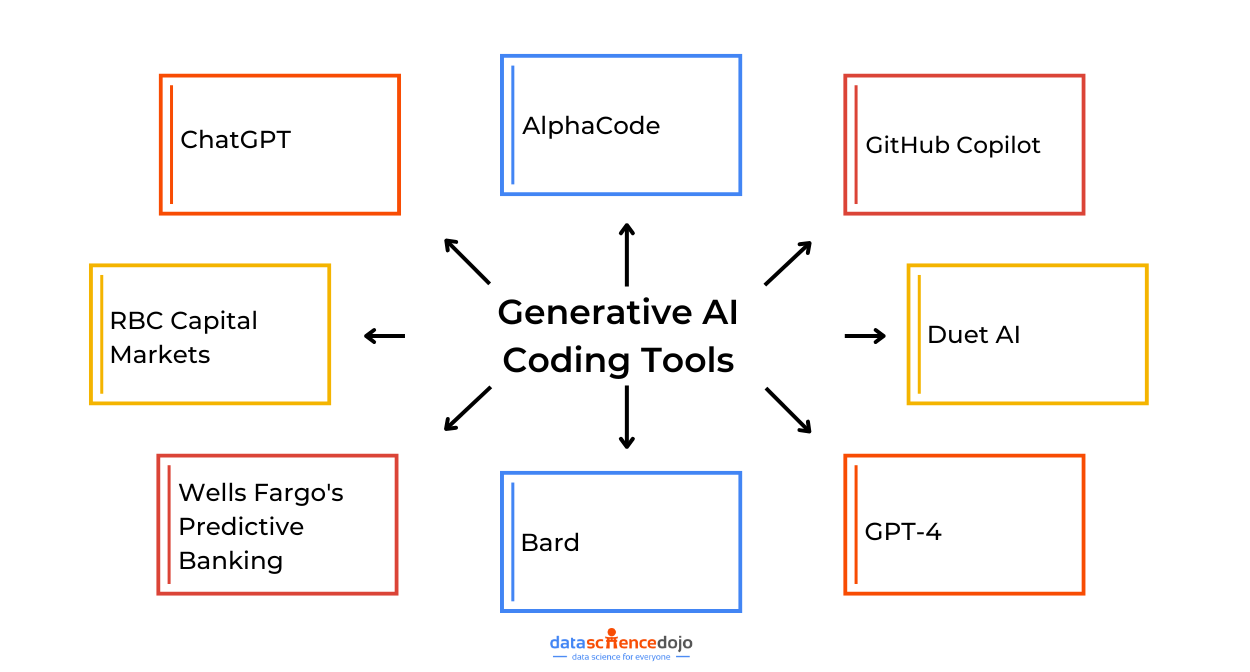
Let’s explore some of the key generative AI coding tools along with their features and examples.