
What are Kaggle Competitions? I didn’t know, so I looked it up. Get started by reading what I learned and find an active list of Kaggle competitions.
Until a few months ago I didn’t know the answer to that question. If you don’t either that’s okay, we’re going to answer it together. But first, you need to know a little background information about this data science network.
Kaggle was founded in 2010 with the idea that data scientists need a place to come together and collaborate on projects. This has transformed into a network with more than 1,000,000 registered users and has created a safe place for data science learning, sharing, and competition.
Using the human competitive spirit, Kaggle created a platform for organizations to host data science competitions that have fueled new methodologies and techniques in data science and given organizations new insights from the data they provided.
Being the competitive person I am, the competition aspect is what originally caught my eye, and gave me the desire to learn about the intricacies of a Kaggle Competition.
How Kaggle works
While combing through the Kaggle website and other informative articles, I found there are three basic steps in Kaggle Competitions.- Preparation: Each Kaggle competition has a host, and each host has to prepare and provide data. When providing data, the host has the opportunity to give additional information such as a description, evaluation method, timeline, and prize for winning.
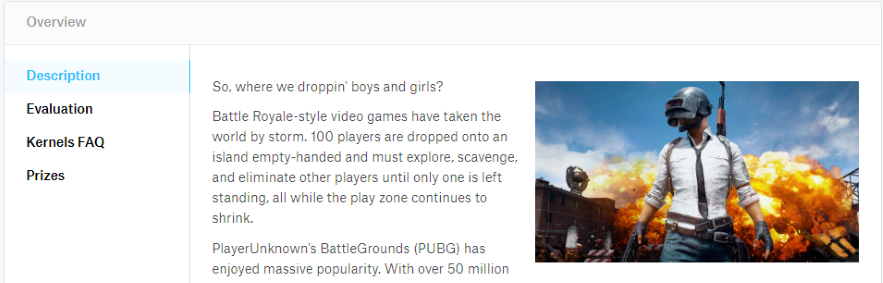 Preparation of a Kaggle competition with the details
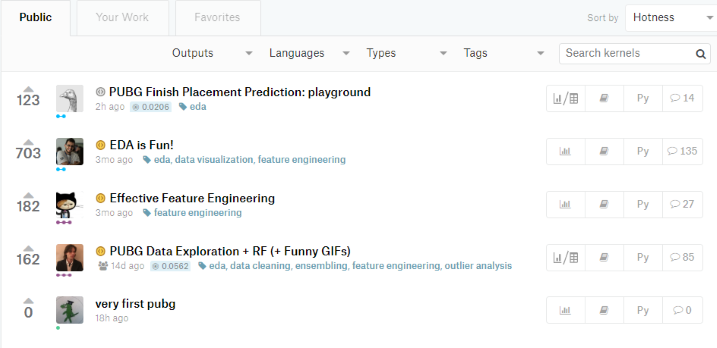
- Experimentation: At this time, you've had your morning coffee, you've read all the information in the overview 500 times, and you're ready to win 1st place. Now is the time to experiment, submit, and learn. There are three ways to upload your work:
- Kaggle Kernels
- Manual Uploads
- Kaggle API
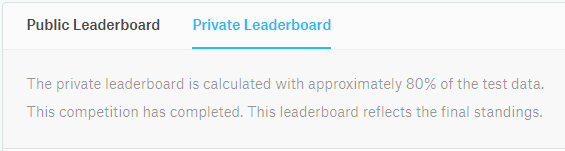
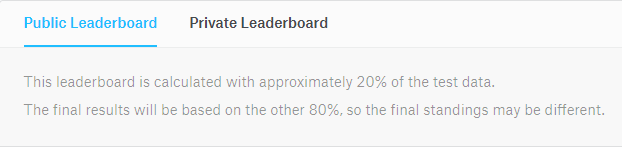
- Results: In every Kaggle competition, there are public and private leaderboards. Be warned, the leaderboards are VERY different. The public leaderboard is based on a small percentage of the test data decided by the host. Although it gives you a good idea, it does not always reflect who will win and lose.
Active Kaggle competitions
[Updated May 6, 2019]Kaggle competitions have a limited amount of time you can enter your experiments. This list does not represent the amount of time left to enter or the level of difficulty associated with posted datasets. One way to determine the level of difficulty is to look at the prize.
Typically, the larger the prize, the more difficult/advanced the problem is. You can also look at the type of competition. You can find the four categories and Kaggle’s description of them below.
- Featured: "These are full-scale machine learning challenges which pose difficult, generally commercially-purposed prediction problems."
- Research: "Research competitions feature problems which are more experimental than featured competition problems."
- Getting Started: "These are semi-permanent competitions that are meant to be used by new users just getting their foot in the door in the field of machine learning."
- Playground: "These are competitions which often provide relatively simple machine learning tasks, and are similarly targeted at newcomers or Kagglers interested in practicing a new type of problem in a lower-stakes setting."
- Two Sigma Using News to Predict Stock Movements
- Type: Featured
- Teams: 2,902
- Prize: $100,000
- LANL Earthquake Prediction
- Type: Research
- Teams: 573
- Prize $50,000
- Google Landmark Recognition 2019
- Type: Research
- Teams: 96
- Prize: $25,000
- Google Landmark Retrieval 2019
- Type: Research
- Teams: 96
- Prize: $25,000
- Freesound Audio Tagging 2019
- Type: Research
- Teams: 521
- Prize: $5,000
- Digital Recognizer
- Type: Getting Started
- Teams: 2,680
- Prize: Knowledge
- Titanic: Machine Learning from Disaster
- Type: Getting Started
- Teams: 10,234
- Knowledge
- House Prices: Advanced Regression Technniques
- Type: Getting Started
- Teams: 4,443
- Prize: Knowledge
- ImageNet Object Localization Challenge
- Type: Research
- Teams: 31
- Prize: Knowledge
- Predict Future Sales
- Type: Playground
- Teams: 2,170
- Prize: Kudos
- iMaterialist
- Type: Research
- Teams: 36
- Prize: Kudos
- iNaturalist
- Type: Research
- Teams: 120
- Prize: Kudos
- iWildCam 2019 - FGVC6
- Type: Research
- Teams: 159
- Prize: Kudos
- iMet Collection 2019 - FGVC6
- Type: Research
- Teams: 369
- Prize: Kudos
- Aerial Cactus Identification
- Type: Playground
- Teams: 507
- Prize: Knowledge
- TMD Box Office Prediction
- Type: Playground
- Teams: 971
- Prize: Knowledge
Want to build AI agents that can reason, plan, and execute autonomously?
Learn more