
This blog digs deeper into different data mining techniques and hacks for beginners.
Data mining has become increasingly crucial in today’s digital age, as the amount of data generated continues to skyrocket. In fact, it’s estimated that by 2025, the world will generate 463 exabytes of data every day, which is equivalent to 212,765,957 DVDs per day! With such an overwhelming amount of data, data mining has become an essential process for businesses and organizations to extract valuable insights and make data-driven decisions.
According to a recent survey, 97% of organizations are now investing in data mining and analytics, recognizing the importance of this field in driving business success. However, for beginners, navigating the world of data mining can be challenging, with so many tools and techniques to choose from.
To help beginners get started, we’ve compiled a list of ten data mining tips. From starting with small datasets to staying up-to-date with the latest trends, these tips can help beginners make sense of the world of data mining and harness the power of their data to drive business success.

Importance of Data Mining
Before moving forward with data mining tips, let's first discuss its importance.Data mining is a crucial process that allows organizations to extract valuable insights from large datasets. By understanding their data, businesses can optimize their operations, reduce costs, and make data-driven decisions that can lead to long-term success. Let’s have a look at some points referring to why data mining is really essential.
- It allows organizations to extract valuable insights and knowledge from large datasets, which can drive business success.
- By analyzing data, organizations can identify trends, patterns, and relationships that might be otherwise invisible to the human eye.
- It can help organizations make data-driven decisions, allowing them to respond quickly to changes in their industry and gain a competitive edge.
- Data mining can help businesses identify customer behavior and preferences, allowing them to tailor their marketing strategies to their target audience and improve customer satisfaction.
- By understanding their data, businesses can optimize their operations, streamline processes, and reduce costs.
- It can be used to identify fraud and detect security breaches, helping to protect organizations and their customers.
- It can be used in healthcare to improve patient outcomes and identify potential health risks.
- Data mining can help governments identify areas of concern, allocate resources, and make informed policy decisions.
- It can be used in scientific research to identify patterns and relationships that might be otherwise impossible to detect.
- With the growth of the Internet of Things (IoT) and the massive amounts of data generated by connected devices, data mining has become even more critical in today's world. Overall, it is a vital tool for organizations across all industries. By harnessing the power of their data, businesses can gain insights, optimize operations, and make data-driven decisions that can lead to long-term success.
Data Mining Techniques and Tips For Beginners
Now, without any further ado, let’s move toward some tips and techniques that can help you with data mining.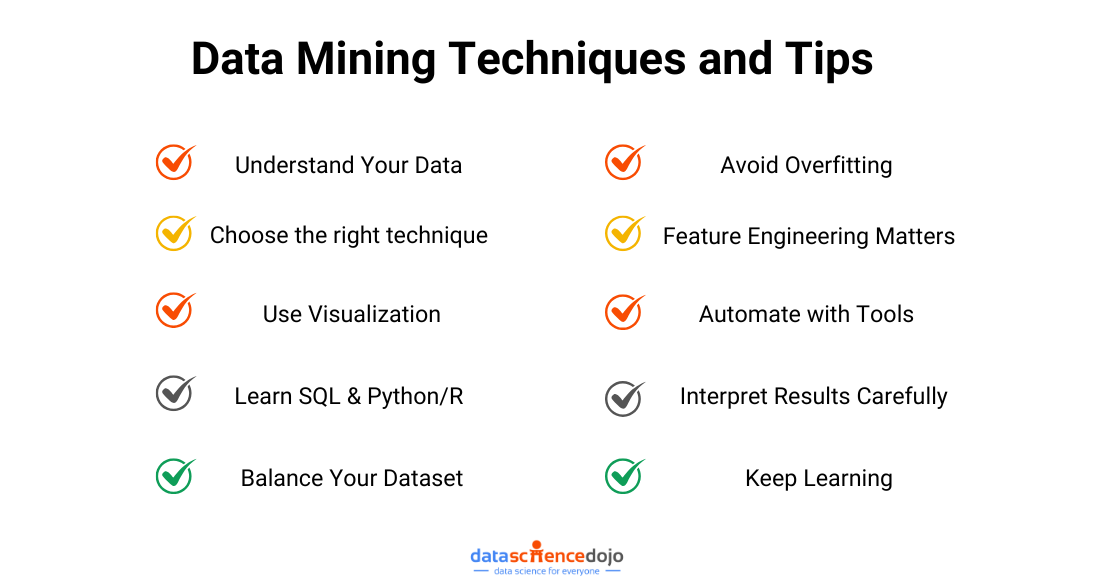
1. Understand Your Data
2. Choose the right technique
3. Use Visualization
Numbers can be overwhelming, but visualization makes patterns clear. Before diving into algorithms, plot your data to understand distributions, trends, and relationships.
Histograms show how data is spread, while scatter plots reveal correlations. Use line charts to track trends over time and box plots to catch outliers that might distort results.
For categorical data, bar charts and pie charts make comparisons easy. If you're working with many variables, heatmaps and pair plots uncover hidden relationships.
Even after building a model, visualization helps! Use confusion matrices, ROC curves, and precision-recall graphs to evaluate performance. Tools like Matplotlib, Seaborn, and Tableau make this process simple. A good chart can reveal insights that raw numbers might miss!

4. Learn SQL & Python/R
Data mining starts with data, and SQL is key for retrieving it. Learn how to filter, sort, join, and aggregate data efficiently using SQL queries. It’s the go-to tool for handling databases, whether small or massive.
Once you have your data, Python and R help you clean, analyze, and model it. Python is great for automation, machine learning (Scikit-learn, TensorFlow), and visualization (Matplotlib, Seaborn). R excels in statistical analysis and data visualization (ggplot2, dplyr).
Knowing both SQL and a programming language like Python or R gives you the power to extract, transform, and analyze large datasets efficiently. The better you get at these tools, the faster and smarter your data mining process will be!
6. Avoid Overfitting
Overfitting occurs when a model learns the noise in the training data instead of the actual patterns, making it perform exceptionally well on training data but poorly on unseen data. This leads to models that are too complex and overly specific to the dataset. To avoid this, use cross-validation, which trains the model on different subsets of the data to ensure it generalizes well. Pruning is useful for decision trees, helping remove unnecessary branches that don’t contribute much to predictions.
Regularization techniques like L1 (Lasso) and L2 (Ridge) penalties control model complexity by reducing excessive reliance on specific features. Always monitor your model’s performance on test data to ensure it doesn’t just memorize but truly understands the data.
Want to build AI agents that can reason, plan, and execute autonomously?
Learn more