
Think about how much time we spend on small, repetitive tasks every day. Answering emails, updating spreadsheets, saving files, or copying data from one app to another. Each task might take only a few minutes, but together they consume hours of our week.
Now imagine if these tasks could take care of themselves. Imagine if your email could be sorted, important notes stored, and reminders sent to you automatically, all without you touching a button. That is the power of automation.
And when we add AI agents into the mix, things become even more exciting. Instead of just following rigid rules, AI can help automations understand, reason, and adapt.
In this guide, we’ll walk through what automation is, how AI agents expand its possibilities, which tools you can use to get started, and a simple hands-on example using n8n to tie it all together.
Understand how AI agents go beyond rules and act autonomously.
What is Automation?
At its simplest, automation is about letting software handle routine tasks, so you don’t have to. Think of it as a set of “if this, then that” instructions.- If someone fills out a form, add their details to a spreadsheet.
- If an order is placed, send a thank-you email.
- If a file is uploaded, back it up to the cloud.
How AI Agents Make Automations Smarter
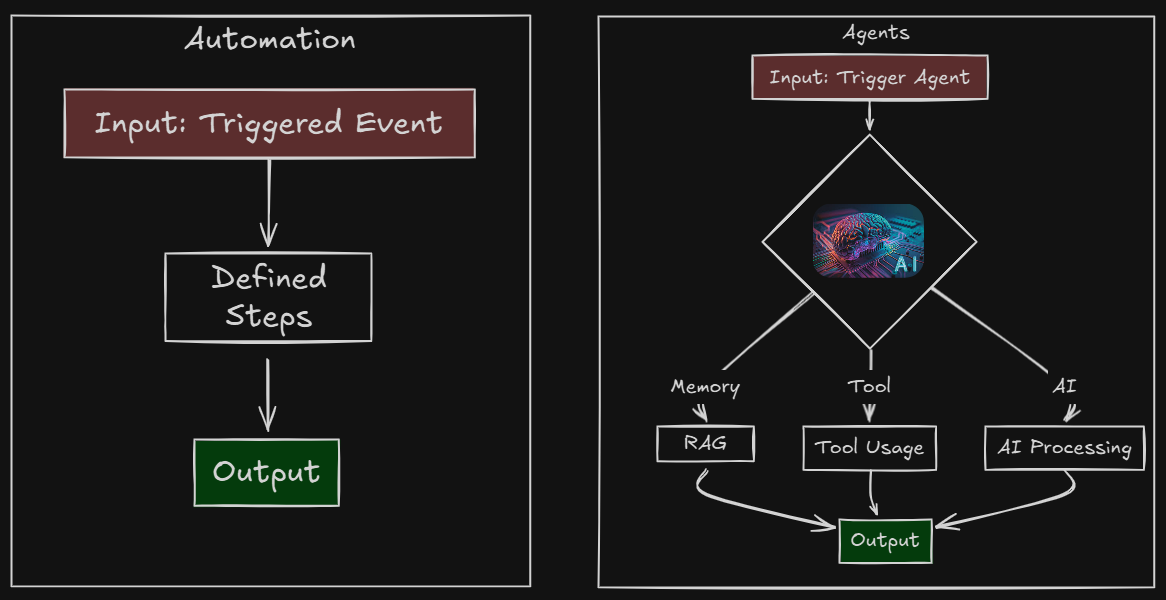
While traditional automation is powerful, it has limits. It can only follow rules you give it. What happens when a task requires judgment, creativity, or understanding context?This is where AI agents come in. Unlike simple rule-based systems, AI agents can:
- Read and understand text, not just keywords.
- Summarize documents or emails.
- Categorize information based on meaning, not rigid filters.
- Decide the next best action depending on the situation.
Here’s a simple illustration that shows how automation runs on strict rules, while AI agents can adjust and choose their own path.
Tools That Make Automation Possible
The good news is you don’t need to be a programmer to build these automations. Today, several tools make it simple for anyone to connect apps, add AI, and create workflows. Let’s look at a few popular ones:n8n
n8n is an open-source automation tool that gives you control and flexibility. It has a drag-and-drop interface where you connect apps like Gmail, Slack, Notion, and even AI services. You can host it yourself, which makes it a great option if you care about data privacy.Zapier
Zapier is one of the most widely used automation platforms. It connects with thousands of apps, so you can quickly build workflows without technical knowledge. For beginners, it’s one of the easiest ways to start automating tasks.Make (formerly Integromat)
Make also offers a visual way to build automation, but it shines when workflows get more complex. If you want detailed control over each step in a process, Make is worth exploring.Turn insights into action by automating your data flow from Azure Synapse to SharePoint Excel.
AI-Centered Platforms
Some tools focus directly on building AI-powered workflows:- Flowise lets you create conversational AI agents with a visual editor.
- Relevance AI helps automate data-heavy tasks with AI models at the core.
Discover tools that empower developers to create intelligent, autonomous agents
Examples of Automation with AI
To see how automation and AI come together, let’s look at a few practical scenarios.-
Smarter Email Management
- New emails are collected automatically.
- An AI agent summarizes the content in plain language.
- Urgent ones are flagged and sent as a short notification.
-
Content Idea Generation
What once took hours of manual research and note-taking is reduced to a few clicks.
Email Summarization Workflow in n8n
Now, let’s make this more concrete with a simple workflow in n8n. Suppose the goal is to summarize incoming emails and send the summaries to Slack. Here’s how that might look:- Trigger Node: Start with the Gmail node, set it to trigger whenever a new email arrives.
- AI Node: Add the Google Gemini node. Connect it to the Gmail node and configure it to summarize the email body text.
- Messaging Node: Add a Slack node. Send the summary as a message to a specific channel or directly to yourself.
- Run the Workflow: Each time an email comes in, the workflow triggers automatically, generates a summary, and posts it to Slack.
Here’s how the workflow looks inside n8n. The flow clearly shows how an email moves through each step until the summary reaches Slack.
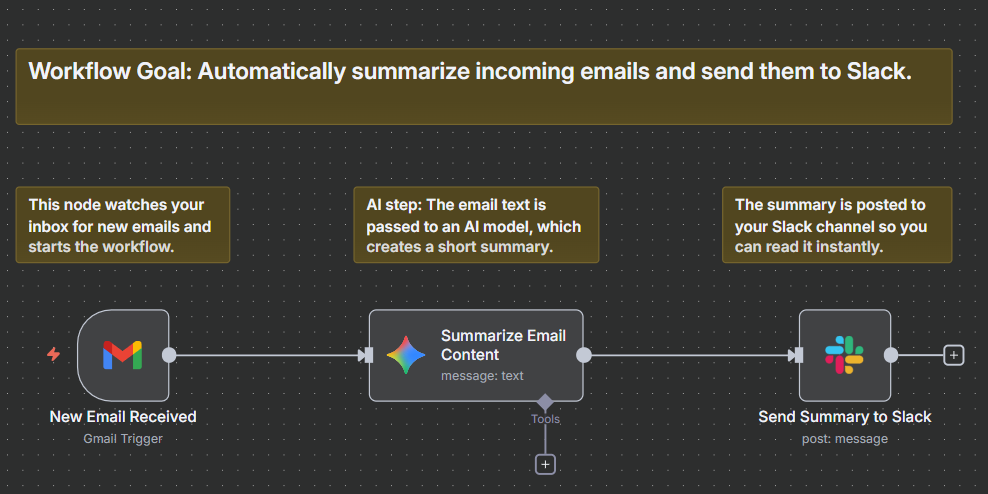
This is just one simple example of what a workflow can do. With n8n and AI, you can design many more automations that fit different needs.
Understand how LangChain enhances AI agent capabilities for complex workflows.
Why Automation and AI Matter Together
When combined, automation and AI deliver more than convenience. They bring real advantages:- Time Savings: Repetitive tasks disappear from your to-do list.
- Consistency: Processes run the same way every time, reducing errors.
- Scalability: You can handle more work without more effort.
- Smarter Workflows: AI helps with understanding and decision-making.
How to Start
Getting started doesn’t need to feel overwhelming. Here’s a simple approach:- Identify a small repetitive task you do often.
- Pick a tool like Zapier, n8n, or Make.
- Build a simple workflow, like moving email attachments to cloud storage.
- Once comfortable, add an AI step, such as summarizing text or categorizing feedback.
Explore how memory integration transforms AI agents from reactive to proactive systems.
Final Thoughts
Automation alone saves time, but with AI agents it becomes transformative. You move from rules that repeat tasks to intelligent systems that adapt and make decisions.Whether you choose n8n, Zapier, Make, or an AI-focused tool like Flowise, the possibilities are wide open. By starting small and growing gradually, you can turn everyday processes into smart workflows that work for you.
The future of work is not just about doing things faster, but about working smarter. Automation and AI agents are tools that bring that future within reach, starting today.
Ready to build the next generation of agentic AI? Explore our Large Language Models Bootcamp and Agentic AI Bootcamp for hands-on learning and expert guidance.
Want to build AI agents that can reason, plan, and execute autonomously?
Learn more