
Concerns about AI replacing jobs have become more prominent as we enter the fourth industrial revolution. Historically, every technological revolution has disrupted the job market—eliminating certain roles while creating new ones in unpredictable areas.

This pattern has been observed for centuries, from the introduction of the horse collar in Europe, through the Industrial Revolution, and up to the current digital age. With each technological advance, fears arise about job losses, but history suggests that technology is, in the long run, a net creator of jobs.
The agricultural revolution, for example, led to a decline in farming jobs but gave rise to an increase in manufacturing roles. Similarly, the rise of the automobile industry in the early 20th century led to the creation of multiple supplementary industries, such as filling stations and automobile repair, despite eliminating jobs in the horse-carriage industry.
Explore 8 Industries Undergoing Robotics Revolution: Security, Entertainment, and More
- Generative AI could add the equivalent of $2.6 trillion to $4.4 trillion annually across 63 use cases analyzed. Read more
- Current generative AI technologies have the potential to automate work activities that absorb 60 to 70 percent of employees’ time today, which is a significant increase from the previous estimate that technology has the potential to automate half of the time employees spend working.
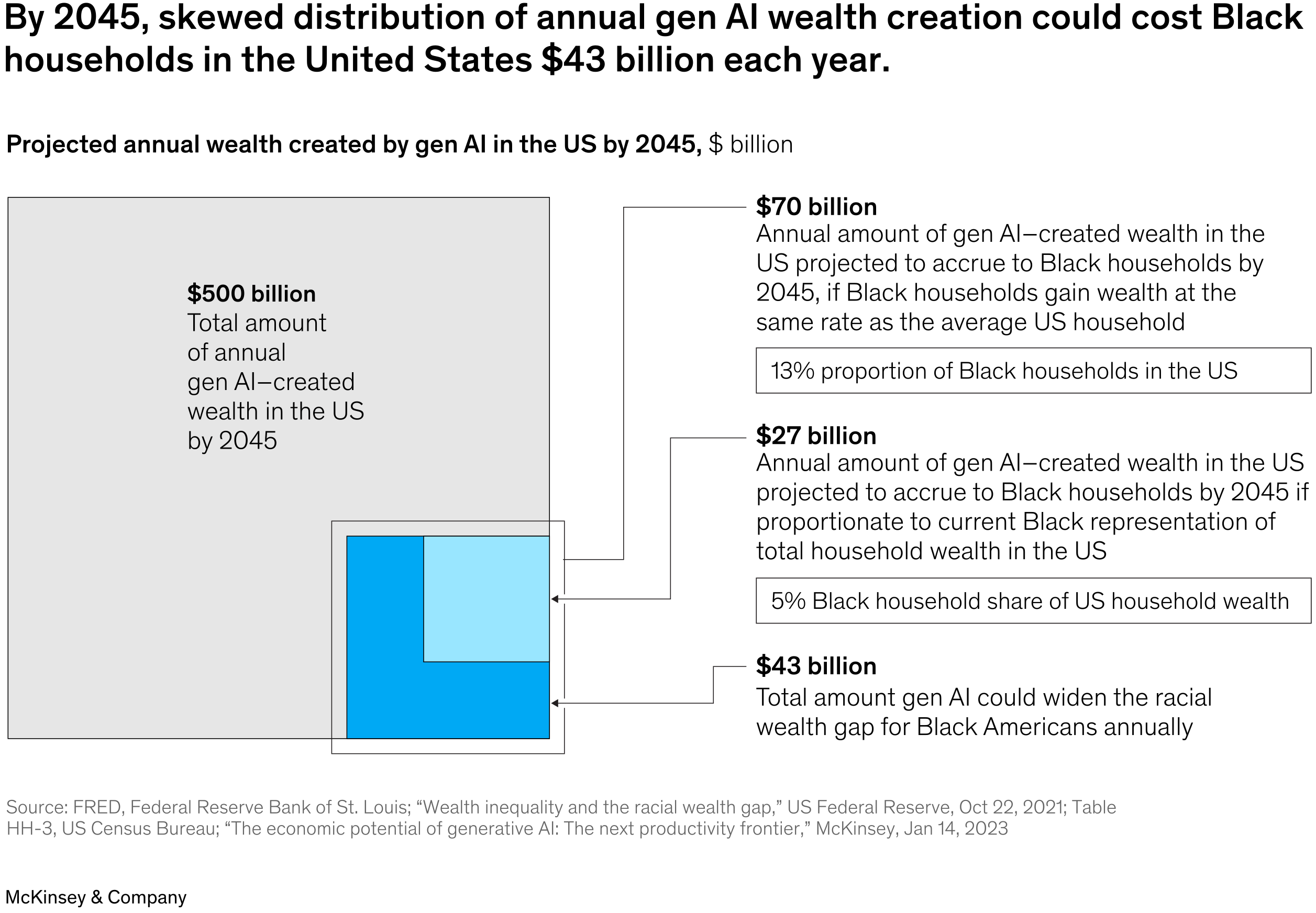
But what’s more concerning is the fact that different communities will face this impact differently.
The Concern: AI Replacing Jobs of the Communities of Color
Regarding the annual wealth generation from generative AI, it's estimated to produce around $7 trillion worldwide, with nearly $2 trillion of that projected to benefit the United States.Explore the Top 7 Generative AI courses offered online
Understand the Generative AI Roadmap
 Source: McKinsey and Company
Read more about The Impact of Generative AI on Jobs: Job Creation or Disruption?
Higher Employment of Black Community in High Mobility Jobs
Mobility jobs are those that provide livable wages and the potential for upward career development over time without requiring a four-year college degree. They have two tiers including target jobs and gateway jobs.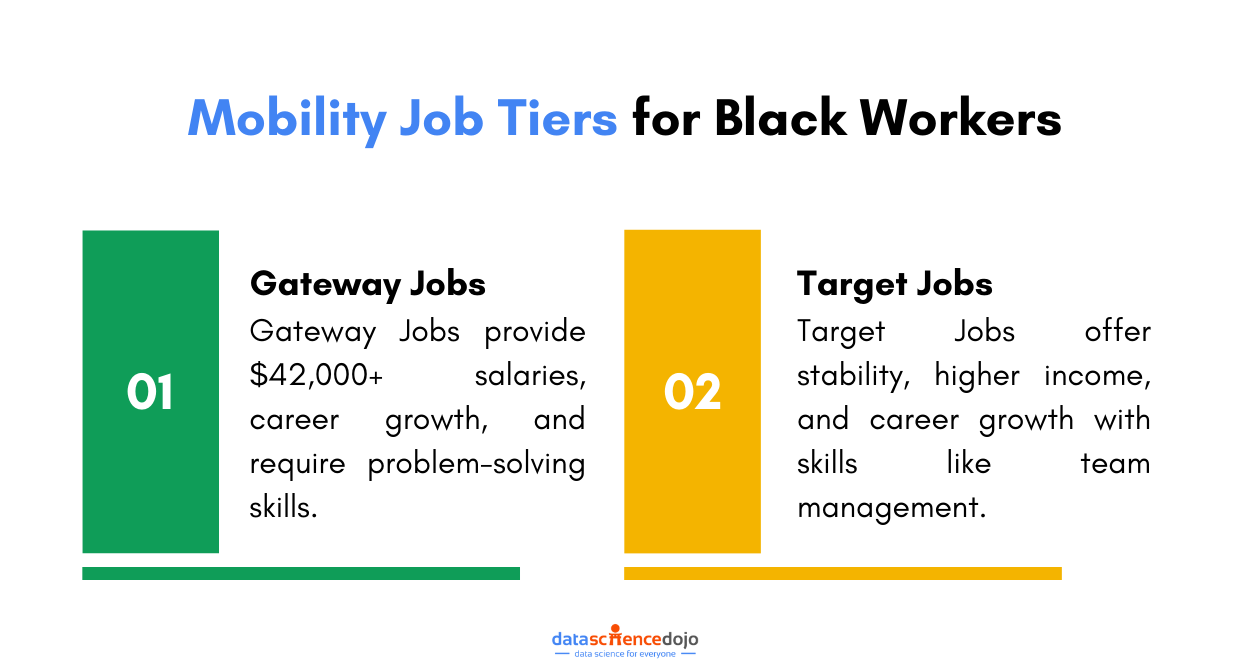
Gateway Jobs
Gateway jobs are positions that do not require a four-year college degree and are based on experience. They offer a salary of more than $42,000 per year and can unlock a trajectory for career upward mobility.An example of a gateway job could be a role in customer support, where an individual has significant experience in client interaction and problem-solving.
Target Jobs
Target jobs represent the next level up for people without degrees. These are attractive occupations in terms of risk and income, offering generally higher annual salaries and stable positions.An example of a target job might be a production supervision role, where a worker oversees manufacturing processes and manages a team on the production floor.
The Affect of Generative AI on Mobility Job Tiers
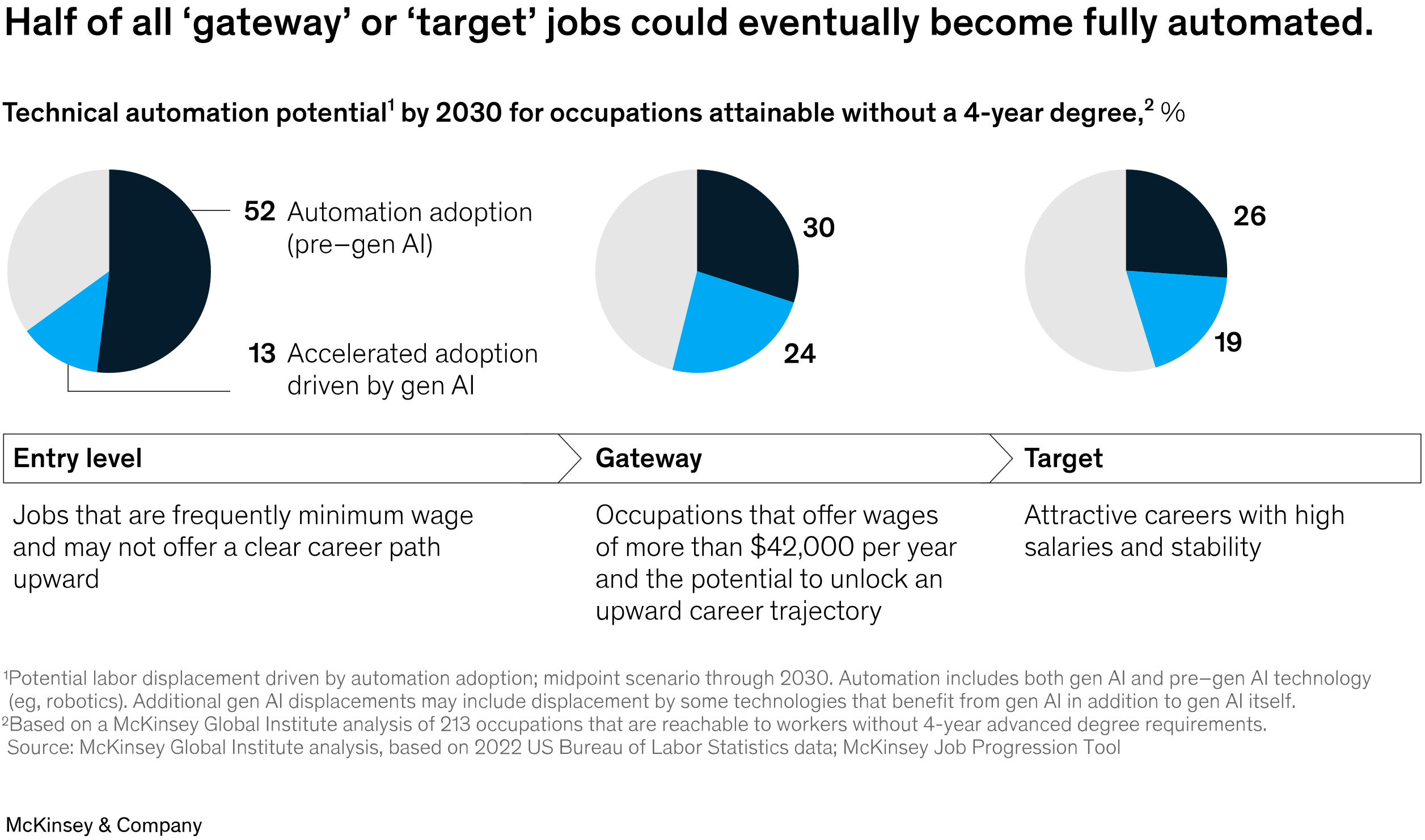
Generative AI may significantly affect these occupations, as many of the tasks associated with them—including customer support, production supervision, and office support—are precisely what generative AI can do well.Learn how is Generative AI Reshaping the Future of Work.
However, generative AI may be able to perform about half of these gateway or target jobs that many workers without degrees have pursued between 2030 and 2060. This could close a pathway to upward mobility that many black workers have relied on which leads to AI replacing jobs for the communities of color.
 Source: McKinsey and Company
Furthermore, coding boot camps and training, which have risen in popularity and have unlocked access to high-paying jobs for many workers without college degrees, are also at risk of disruption as gen AI-enabled programming has the potential to automate many entry-level coding positions.
These shifts could potentially widen the racial wealth gap and increase inequality if not managed thoughtfully and proactively. Therefore, it is crucial for initiatives to be put in place to support black workers through this transition, such as reskilling programs and the development of “future-proof skills”.
These skills include socioemotional abilities, physical presence skills, and the ability to engage in nuanced problem-solving in specific contexts. Focusing efforts on developing non-automatable skills will better position black workers for the rapid changes that generative AI will bring.
Understand Data Scientist Skills essential for a Data Science Job
Harnessing Generative AI to Bridge the Racial Wealth Gap in the U.S.
Explore the Potential of Generative AI and LLMs to Empower Non-Profit Organizations
In financial inclusion, gen AI can enhance access to banking services, helping black consumers connect with traditional banking and save on fees associated with nonbank financial services.
Key Areas Where Generative AI Can Drive Change
AI can be applied to the eight pillars of black economic mobility, including credit and ecosystem development for small businesses, health, workforce and jobs, pre–K–12 education, the digital divide, affordable housing, and public infrastructure.Learn about 15 Spectacular AI, ML, and Data Science Movies
Thoughtful application of gen AI can generate personalized financial plans and marketing, support the creation of long-term financial plans, and enhance compliance monitoring to ensure equitable access to financial products.
However, to truly close the racial wealth gap, generative AI must be deployed with an equity lens. This involves reskilling workers, ensuring that AI is used in contexts where it can make fair decisions, and establishing guardrails to protect black and marginalized communities from potential negative impacts of the technology.
Explore Generative AI in Healthcare
Democratized access to generative AI and the cultivation of diverse tech talent is also critical to ensure that the benefits of gen AI are equitably distributed.
Embracing the Future: Ensuring Equity in the Generative AI Era
In conclusion, the advent of generative AI presents a complex and multifaceted challenge, particularly for the black community. While it offers immense potential for economic growth and innovation, it also poses a significant risk of exacerbating existing inequalities and widening the racial wealth gap.To harness the benefits of this technological revolution while mitigating its risks, it is crucial to implement inclusive strategies. These should focus on reskilling programs, equitable access to technology, and the development of non-automatable skills.
By doing so, we can ensure that generative AI becomes a tool for promoting economic mobility and reducing disparities, rather than an instrument that deepens them. The future of work in the era of generative AI demands not only technological advancement but also a commitment to social justice and equality.
Want to build AI agents that can reason, plan, and execute autonomously?
Learn more